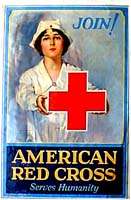
 March 31. The last day of March — the end of Red Cross Month. I discovered very quickly that I set out a rather difficult challenge for myself with this posting…putting together 31 tidbits of information about the American Red Cross, and (attempting to) post those little tidbits on a daily basis. Not easy, by any stretch of the imagination. But – all in all – a rewarding project for me. It drove me to pull some of my books off the display shelf and re-read them…led me to new websites for background information (several of these links are included in the daily entries)…and of course led me to discover new books that I “just had to have”. I hope this (what does one call a posting this massive???) “article”(?) is informative, encourages readers to learn more about their own local Red Cross, and maybe reinforces that pride of service in those who serve the Red Cross today. Lofty goals, I know – but what can I say?
I’ll close this month-long celebration with the dedication offered in the book “The American National Red Cross – It’s Origin, Purposes and Service” by Ms Sarah Elizabeth Picket (1923)
“To All Who Love and Serve The Red Cross and Humanity”
March 30. We know that Clara Barton worked tirelessly to bring the American Red Cross to life in the late 1800’s, and remained a strong and driving force for the organization for many years after that. And if you dig a little bit, you might find reference to how she was intrigued by the humanitarian work being done by the International Red Cross, and indeed had the opportunity to serve with the International Red Cross for a time while overseas. Her experiences during that time of service so moved her that she felt compelled to petition International Red Cross leadership for permission to pursue the establishment of a Red Cross society in America. Much of that information can be found on various American Red Cross websites and in numerous publications documenting the history of the organization.
But what’s really interesting is delving a bit deeper into the object of her motivation – the International Red Cross.
A Swiss businessman by the name of Henri Dunant happened upon the aftermath of the Battle of Solferino while traveling. The level of human suffering he witnessed on that battlefield moved him to immediate action. Dunant recruited volunteers from a nearby village to help evacuate the wounded soldiers to a nearby church where the wounded received care for their wounds, and the dying were provided comfort and dignity in their last hours. From this event sprung two ideas – a network of volunteers to assist and care for those wounded in battle, regardless of what side they fought on; and a treaty of sorts among countries to provide for the safety of the medical workers and those wounded and unable to fight.
These two ideals became the International Red Cross, and the First Geneva Convention. One battle + one man + two ideas = One mission … Humanity in the midst of war.
Amazing, huh?
Henri Dunant received the very first Nobel Peace Prize in 1901, but his final years were not spend in the spotlight. Indeed, Henri Dunant spent his final years in near solitude living in a hospice in the small village of Heiden. Mr Dunant died in 1910, with no funeral and no mourners to grieve his passing.
March 29. Slightly different angle for today’s entry — thought I’d simply share a short presentation that has some quick little tidbits (and a few nice pictures) from Red Cross’ early days. Hope you enjoy! Brief ARC History
March 28. On September 24, 1990 the American Red Cross Holocaust and War Victims Tracing Center was opened. the Center assists US residents searching for proof of internment, forced/slave labor or evacuation from former Soviet territories either for themselves or for family members. This Center is part of a national program for those seeking the fates of loved ones missing since the end of WWII and the Holocaust and its aftermath.
Some quick facts on this service:
- All tracing services at the Center are free of charge.
- The Red Cross is able to tap into the worldwide network of Red Cross and Red Crescent societies, and also consults museums, archives and international resources
- Cases remain open, and new information is immediately shared with the inquirer
- Cases are initiated at the local chapter location.
The Center has sought the fate of more than 45,000 individuals since the Holocaust and WWII.
March 27. The American Red Cross is one of 186 Red Cross/Red Crescent Societies that comprise the Red Cross Movement around the world, meaning that there is a Red Cross society in nearly every country in the world. Each of these societies is chartered by their respective governments, and provide a wide range of services including: disaster relief, health and social programs, relief to those affected by conflicts within their own borders, and assisting other societies in their efforts through the coordination network of the Federation and the ICRC. Each country is allowed to charter only one Red Cross society within its borders. Globally, National Societies have nearly 97 million members and workers, and have been able to provide assistance to approximately 233 million people each year.
Though driven by the same mission to provide humanitarian relief to those affected by disaster, conflict or other issues, the societies do tend to have different types of activities that they are most known for. For example; The American Red Cross routinely sends volunteers to meet with those displaced by residential fires…not a common theme in other countries. The Magen David Adom (Israel’s society) has a large contingent of highly trained emergency medical personnel. The Swedish Red Cross society provides hundreds of International Humanitarian Law trainings every year to government and educational entities, as well as operates specialized treatment centers for those affected by torture.
Meeting the needs of the community served…Guided by the Seven Fundamental Principles… Serving Humanity.
March 26. As a member of the International Red Cross and Red Crescent Movement, the American Red Cross (and other Red Cross /Red Crescent Societies) has a key role in upholding and abiding by the Seven Fundamental Principles. These Principles are the same for all members of the Movement, and are considered to be the foundation of the organization.
Humanity ~ Impartiality ~ Neutrality
Independence ~ Voluntary Service ~ Unity ~ Universality
If you’d like to know more about these principles, click here.
March 25. In a previous entry, I mentioned the various branches of service that were present in the Red Cross during World Wars I and II. One of those mentioned was the Production Corps. Production Corps volunteers worked to fill the need for several supply items needed to keep soldiers warm and to help those in veteran and civilian hospitals. Crews of volunteers worked to knit sweaters, socks and hats – while others worked to sew bandages that were used on the battlefield and in hospitals, and even pajamas and the like for those in hospitals.
The knitting program was very popular, and volunteers were recruited from all walks of life. Military patterns were developed to coordinate with Navy and Army uniforms, and the knitters were required to knit using olive drab or navy blue yarns. Other specialized patterns were developed to be more suitable for convelescing soldiers special needs. A selection of World War II knitting patterns are available from the Red Cross’ website, as well as some current styled patterns for adults and children alike. “Knit Your Bit” all!
March 24. If you spend any time at all reading through historical data on the American Red Cross, you can’t help but notice that a very large portion of volunteers in Red Cross services over the years have been women. Today, more than half of the disaster workers registered in the American Red Cross volunteer database are female – clearly continuing that tradition started in 1859 when Henri Dunant recruited nearby village women to help evacuate and care for the wounded and dying soldiers in the Battle of Solferino. Great things have been accomplished by the men who serve and have served the organization – I’m not saying otherwise. Just paying a small homage to more of the Angels who have served before us.
A hospital worker named Esther Richerds (from San Fransisco) was the first American Red Cross woman killed over seas in World War II. Ms Richards actually received the Purple Heart for a pervious injury – and was awarded the War Cross of Military Valor by the Italian government after losing her life during a German bombing raid in Italy.
On the homefront, millions more served as both paid and volunteer workers in various activities. More than 300 women died during World War I at home and abroad. This includes nurses who battled the Spanish influenza pandemic in 1918. More than 50 women died overseas during World War II.
March 23. Vietnam – The war that is more than a history lesson for so many, it is a part of their lives. And yes, the American Red Cross was right there…once again providing services to our military forces and their families back home.
Two core components of Red Cross services on the home front included: Service to Military Families (SMF), which included messaging, counseling, assisting families who were applying for government assistance programs and other items; and Service at Veterans Administration Offices (SVAO), which included counseling services for a variety of issues and otent representing veterans in application for benefits or other government programs.
Among the special programs offered to military service members and their families were:
- A Free Phone Call Home: The Red Cross offered a free phone call home to all injured military personnel on their return home. Red Cross paide for 112,453 of these calls during the war years.
- Shop Early Program: American Red Cross volunteers assembled and sent special Christmas packages to every serviceman and woman in Vietnam. Between 1966 and 1972, more than 2,950,000 of these Yuletiide packages were dispatched.
- Operation Helpmate: Some Red Cross chapters “adopted” military hospitals and recreation units in South Korea and other parts of the Far East, to which they regularly sent books, mag recreational supplies.
March 22. Whenever I have the chance to talk to people about the history of the American Red Cross, discussion quite often centers around the organization’s activities in World War I and World War II. Just looking on the internet, one can find site after site with stories and statistics about Red Cross activities during these times. But our history doesn’t end there by any stretch of the imagination.
The Korean war began in 1950, and ended in 1953. It is often referred to as “The Forgotten War”, because it was so overshadowed by World War II and by the fact that it was a war with no victor. The Korean war ended with an armistice rather than a peace treaty. Regardless of its ambiguous place in history, the Korean War resulted in an estimated 4 million military and civilian deaths and involved the military forces from 20 nations.
And the American Red Cross was there – providing the same services to the military as in previous wars.
While its war-time activity never reached the mammoth scale of the previous world wars, the American Red Cross was successful in meeting the challenges placed on the organization by the Korean War. At the peak of war-time activity in 1953, the Red Cross was engaged in multiple “services” utilizing thousands of volunteers abroad and at home. Monthly average activity at this time included: 10,000 volunteers assigned to military installations at home and abroad; 54,000 volunteers assigned to the blood collection program; more than 25,000 volunteers assigned to military hospitals; another 28,000 volunteers worked in Veterans Administration hospitals; and 9,000 volunteers participated in Home Service. Two American Red Cross workers lost their lives in service to the military in the Korean War.
March 21. In several pieces that I’ve read on American Red Cross history, reference to “Rhymes of the Red Cross Man” have appeared over and over. Curiosity finally won out, and I took a little side trip to see what I could find.
In 1916, a collection of poems (mostly having to do with war) by Robert W. Service was published. Mr Service was a British subject and served in World War I as an ambulance driver for the Canadian Red Cross, and also a war correspondent for the Canadian government. Mr Service had a brother (Lieutenant Albert Service) who was killed in action while fighting in France in 1916. Robert Service fled his home country at the start of World War II, but was able to return at war’s end, where he remained until he died in 1958.
March 20. A sad fact of life that became quickly evident was that there would be men returning from the war in need of so much more than just emotional support. Men would be returning missing limbs, blind, or with other injuries so severe that some sort of physical rehabilitation would be necessary. Again, the Red Cross was at the forefront of those efforts.
In 1917, the Red Cross Institute for Crippled and Disabled Men was established in New York City. The Institutes’ main activities were mainly experimental and academic in nature – compiling and republishing papers documenting the results of some of the very successful rehabilitation work being accomplished in Europe; developing a census of those with disabilities in New York City; and experiments in vocational training in various trades to try to determine what benefits these veterans might derive from them.
As an aid to the blind, the Red Cross established an Institute for the Blind in Baltimore, MD. Among other works, the Institute also provided living quarters for relatives of soldiers who came to visit them in the nearby hospital.
It was noted that the American Red Cross – through its exhaustive work in the rehabilitation area of service – was completing its circle of service. Red Cross saw the men off to war – welcomed them back home – and was remaining by their side as they rediscovered new purpose and function in life after war.
March 19. One of the service branches in the Red Cross during those years encompassed by World War I was that of Home Services. Red Cross Home Services members were tasked with providing support to the family members of our service men who were off fighting the war…helping find solutions to the wide variety of problems and issues that were coming to light – many times serving as a lifeline to both the families of the men fighting in France and beyond, and the men themselves.
It was recognized even back then that a soldier who was worried about family and the state of affairs back home, was not as strong as one who was not preoccupied with such matters. So, if a soldier was worried about things back home, he was encouraged to speak to the “Red Cross Man”. Word would then be relayed back to the appropriate office, and the Home Services mechanism would be activated.
These volunteers worked very much under the radar, not drawing a lot of attention or public notice – as that would have detracted from their very purpose. These dedicated members served as guide, counselor and friend to countless families across the country, attached to all branches of military service. A six-week training course was even developed to help prepare workers to serve not only the families of those at war, but to work with those returning from war as well, providing re-education and other support if wounded or disabled during their service.
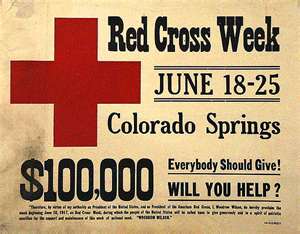
March 18. In January 1917, Red Cross managers began a Membership Drive. Their goal? To reach the mark of 1 million members by year’s end. By September of that year, the membership rolls were sitting at approximately 6 million members. By the end of that first membership drive, there were 22 million Red Cross members on Red Cross lists across the country. In conjunction with the growth of membership, the number of chapters surged forth at a pace that boggles today’s mind. Before the war, there were some 600 Red Cross chapters in the country. By the end of 1917, there were literally thousands of Red Cross chapter units in the country. Patriotism and service to one’s community was taking root and blossoming!
March 17. As the country’s men began answering the call to patriotic duty, the women of America found themselves in new roles. Sole provider for a family, manager of the family farm…roles that many women were not at all prepared for. Some became overwhelmed, while others discovered new strength and purpose in these (and other) roles.
From the day they first took on the burden of war through October 1918, the women of America made, packed and shipped 253,000,000 surgical dressings; 22,000,000 articles of medical supplies; 14,000,000 sweaters/socks/comfort bags, etc. for soldiers and sailors; and 1,000,000 refugee garments. The little red labels sewn into each and every garment, by women of all backgrounds in chapters across the country, carried the song of goodwill around the world.
March 16. The first local Red Cross society in America was organized at the Lutheran Church (Dansville, NY) on August 22, 1881. The Dansville Chapter is now known as the “Clara Barton Chapter #1”.
March 15. We all know that Clara Barton is the official founder of the American Red Cross. But did you know that she was not the first person to present and advocate for the creation of the organization? Dr Henry W Bellows (president of the United States Sanitary Commission during the Civil War) carried on his organizations work by establishing the American Association for the Relief of Misery on the Battlefield, which flew the Red Cross flag. The group collected funds for war relief during the Franco-Prussian War, but disbanded in 1872 when Dr Bellows was unable to convince the U.S. Government to sign off on the Geneva Convention of 1864.
Miss Barton took up that battle, and presented her case in 1877, but she too was unsucessful. The U.S. Government reportedly avoided signing the Geneva Convention treaty out of its fear of “entangling alliances”. But Clara Barton would not be deterred in her mission. She persevered, and after years of lobbying President James A Garfield asked his secretary of state to “hear Miss Barton out” in 1881. President Garfield agreed that the treaty should be signed, but was assassinated before completing that task. President Chester Arthur followed through with the signing on March 1, 1882.
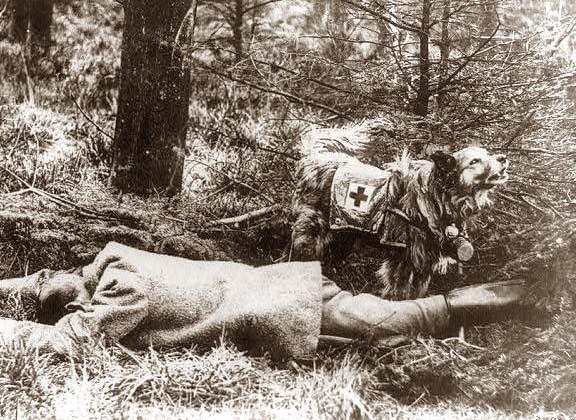
March 14. Dogs are man’s best friend – of that there is no doubt nor dispute. So imagine my excitement when I found articles about Red Cross Dogs!
Red Cross dogs were trained to locate the wounded and retrieve a piece of clothing from the soldier – such as a hat or other article. They then delivered that article back to the main group and then lead the medics/stretcher bearers back to the wounded man/men. These animals were also fitted for gas masks so that they could continue their life-saving mission in the worst of conditions.
Be sure to hug your puppers folks!
March 13. Red Cross Chairman Judge Payne (circa 1930’s) – “The American Red Cross has no political opinion and only one religion – Service to Humanity.”
March 12. Members of the American Red Cross are very well versed in the phenomenon of “the pins”. There are pins for chapters; pins for disaster relief operations; pins for special events; and pins for specific activities within the Red Cross (actually, lots more than that, but I’ll stop the list there…). And we do love to collect our pins! They are a favorite search for many collectors on Ebay, at garage sales, estate sales, antique shops and anyplace where one might find old forgotten pieces of Red Cross history. What was interesting to me, was finding out that pins go way back to our early years….at least back to 1923 (the year one of my reference books was published).
Each branch of Volunteer Service (at the time this particular reference was published, there were seven branches of service listed) had its own special pin. The pins were available for purchase from the Chapter by a member after they had been appropriately enrolled. Pins were available at a cost of $1 each. At that time, each pin had a serial number on the back, along with a service letter. Each branch’s design, while similar in basic design, featured a different color border and official insignia.
- Administrative Corps – Red border, no insignia and the letter A
- Clerical Corps – Yellow border, crossed quill pens for insignia and the letter B
- Production Corps – Dark blue border, a sun for the insignia and the letter P
- Canteen Service – Light blue border, heads of wheat for the insignia and the letter C
- Motor Corps – Green border, a wheel for the insignia, and the letter M
- Health Aides – White Maltese Cross for the insignia, and the letter H
- Hostess and Recreation Service – Green border, HR for insignia, and the letter R
Brief descriptions of these eight branches of service (and others that were added in later years) may be found in the March 8th entry of this piece.
March 11. In 1877, Japanese Count Tsunetani founded a relief organization called the Philanthropic Society, whose mission was to care for the war-injured during the Satsuma Rebellion. Its name was changed to the Japanese Red Cross in 1887, after fulfilling the requirements as set forth by the ICRC (International Committee of the Red Cross). The Society’s first disaster response followed later that same year, with the eruption of Mount Bandai.
The Japanese Red Cross was instrumental in the rescue of several Russian POW’s during the Russo-Japanese War (1904-1905). This action earned Japan a great deal of positive public relations in the western press. Following the 1906 San Francisco Earthquake, the Japanese Red Cross raised $146,000 in support of the American relief effort – the society’s first overseas relief effort.
The Japanese Red Cross’ relief efforts continued during World I, and the Second Sino-Japanese War. Following World War II, the Japanese Red Cross was reformed under American Advisors.
To those who have lost someone in yesterday’s tragic event, our hearts are with you. For those awaiting word on a friend or loved one, strength be with you in these difficult hours.
March 10. If you’re doing any kind of digging looking for historic information on the American Red Cross, you’re bound to come across a document that lists “100 Significant Dates in Red Cross History”. While I think it’s very interesting to look at these dates, and ponder the people represented on such a list, I promise not to drone on by listing all 100 events. Instead, in honor of Red Cross Month, I’ll just pull out those events listed in the month of March. Enjoy!
- March 16, 1882 – US Senate ratifies first Geneva Convention
- March 25, 1911 – Red Cross comes to the aid of families of mostly women who were victims of the Triangle Shirtwaist Factory fire in New York City
- March 19, 1913 – President Woodrow Wilson named first honorary president of the American Red Cross, thus setting a precedent for all chief executives that have followed.
- March 7, 1932 – Red Cross begins distribution of government surplus wheat and cotton products to victims of the drought during the Dust Bowl.
- March 20, 1945 – President Franklin D Roosevelt delivers his final radio address, speaking in support of the Red Cross War Fund.
- March 27, 1964 – Red Cross assists victims of massive earthquake in Anchorage, Alaska
- March 1, 1999 – Red Cross begins Nucleic Acid Testing (NAT) which provides early detection of HIV and Hepatitis C in blood.
March 9. Did you know that the American Red Cross’ involvement in WWII actually preceded the United States’? When hostilities began in France in 1939, the Red Cross became the primary supplier of relief supplies for civilians distributed by the International Committee of the Red Cross (ICRC). In 1941 the Red Cross began a Blood Donor Service in preparation for America’s entry into the war, and after the attack on Pearl Harbor mobilized volunteers to assist with the care of the sick and wounded.
At the peak of Red Cross wartime activity in 1945, 7.5 million volunteers along with 39,000 paid staff provided service to the military. Throughout the war years, the Red Cross served 16 million military personnel, including one million combat casualties. By the time World War II ended in September 1945, the American public had contributed over $784 million in support of the American Red Cross. Nearly every family in America contained a member who had either served as a Red Cross volunteer, made contributions of money or blood, or was a recipient of Red Cross services.
Phenomenal!
March 8. In today’s Red Cross, there are 8 “Groups” that DSHR (Disaster Services Human Resources) Volunteers can choose from when choosing what they would like to do as part of a disaster response. These Groups are then broken down further into “Activities” and “Positions” – thus offering a very wide array of choices for our volunteers. There’s a little bit of everything there – providing a little something for pretty much anyone looking for volunteer work with the American Red Cross. And that’s just the Disaster side! There’s even more when you factor in Blood Services, Health & Safety, Service to Armed Forces, International Services, Community Disaster Education…you get the picture, I’m sure!
Looking back at some of the Red Cross history tidbits, it’s interesting to see how some procedures/policies seen in today’s Red Cross seem to derive at least some portion of their foundation from procedures/policies present so many years ago. For instance: during the years of World War II, most chapter activities related to the war were organized into 11 Volunteer Corps.
Administration Corps provided administrative support and direction to the programs of the other corps in the Volunteer Special Services. (Administration Corps volunteers numbered 21,347 in 1942-43.)
Arts and Skills Corps began in 1944 as a means for rehabilitation by giving patients an opportunity to do creative and constructive work under the direction of artists and craftsmen. At its peak, the Corps offered instruction in arts and crafts to the war-injured in 105 domestic hospitals (6,645 volunteers in 1945-46).
Braille Corps transcribed books and periodicals for use by the blind. As a national program, the Braille Corps began in the 1920s but ceased operations in 1942 due to technological and commercial advances in transcription that rendered it less essential (3,714 volunteers in 1941-42).
Canteen Corps served snacks and meals at docks, airports, railroad stations, military posts, and at Red Cross blood donor centers, childcare centers, and schools, mostly in the United States. Over the course of the war 163 million cups of coffee, 254 million doughnuts, and 121 million meals were served by the Canteen Corps (105,571 volunteers in 1942-43).
Home Service Corps, the chapter-based, volunteer component of the SAF Home Service, provided care to the families of U.S. service personnel as described in the section above on Service to the Armed Forces (16,033 volunteers in 1943-44).
Hospital and Recreation Corps (later known as the Gray Lady Corps) provided a variety of hostess and recreational services in over 1,000 military and veterans’ hospitals throughout the United States. Services included writing letters, reading to patients, tutoring, running shopping errands, and serving in hospital recreation rooms and at information desks (49,882 volunteers in 1944-45).
Motor Corps consisted almost entirely of women who clocked over 61 million miles answering nine million calls to transport the sick and wounded, deliver supplies, and take volunteers and nurses to and from their posts. In all, 45,000 women served in the Motor Corps during World War II. Most drove their own cars and many completed training in auto mechanics in order to be able to make automotive repairs on their own (44,668 volunteers in 1942-43).
Production Corps, by far the largest of the Volunteer Special Services, made and repaired 64 million pieces of clothing, prepared over 2.5 billion surgical dressings, and assembled over 30 million comfort kits and other articles for use by the U.S. military, the Allies, and civilian victims of the war (3,500,000 volunteers in 1942-43).
Staff Assistance Corps provided various forms of office and administrative support in chapters, hospitals, and other sites of Red Cross activities (128,214 volunteers in 1943-44).
Volunteer Dietitian’s Aide Corps eased the serious shortage of help in dietary departments of an annual average of 260 military and civilian hospitals (7,730 volunteers in 1944-45).
Volunteer Nurse’s Aide Corps members provided vital assistance to overburdened nurses in 2,500 civilian and military hospitals (110,170 volunteers in 1944-45).
In addition to these corps, wives, daughters, and mothers of servicemen on army posts and at naval stations all over the country formed auxiliaries and committees to provide services in collaboration with local Red Cross chapters. At their peak, there were 345 units with as many as 12,000 volunteers a month busily engaged in Production Corps work and other service activities.
March 7. In September of 1918, the deadly Spanish Influenza epidemic began sweeping the country, and the surgeon general of the US Public Health Service called on the Red Cross. Somewhere in the neighborhood of 15,000 nurses, dietitians and others were recruited and sent to work in military camps, hospitals, coal fields and shipyards – where they remained until the epidemic finally subsided (sometime in the spring of 1919). During that epidemic, millions of Americans fell ill – with more than 540,000 individuals dying from the illness. Worldwide, the Spanish influenza epidemic killed some thirty million people.
March 6. In 1912, the Red Cross Town and Country Nursing Service was established primarily to stimulate the development and the supervision of public health nursing services in small (less than 25,000 people) rural towns. The Town and Country Nursing Service was instrumental in establishing training and experience standards for rural nurses, organized nurses who were employed by local Red Cross chapters and other community organizations under the Nursing Service banner, and provided oversight and encouragement to these organizations to continue the provision of this valuable service.
In 1918 the name was changed to the Red Cross Public Health Nursing Service, and the population requirement for operation of the service was removed. 1919 saw an increase in demand from within and without the organization that the American Red Cross should develop activities to help mitigate the yearly death-toll of preventable disease. The placement of a well-trained public health nurse was a widely accepted avenue to achieve this goal, so local chapters were authorized to develop a public health nursing service – with the goal of transferring it to the county or local authorities as soon as the program was deemed successful.
March 5. One of the “activities” available for volunteers to choose when they join the American Red Cross is “Disaster Health Services”. Registered Nurses, EMT’s, Paramedics and other licensed health professionals are able to volunteer and provide much-needed oversight in Red Cross facilities to clients and workers during disaster. But many people don’t realize just how deep that connection is in Red Cross history.
The link between Red Cross’ humanitarian works and those who serve as health care providers goes all the way back to Henri Dunant’s initial plea for volunteers to help care for wounded soldiers following the Battle of Solferino more than 150 years ago. Nurses have always been a pivotal point of service delivery for the American Red Cross, dating back to the 1888 Yellow Fever Epidemic and the 1889 Johnstown Flood. In 1909, the American Red Cross Nursing Service was formally organized by Jane Delano. Ms Delano, and others who followed her, played key roles in the development of American Nursing across the country. Today, there are more than 40,000 nurses involved in all levels and areas of service for the American Red Cross.
Ms Delano died in 1919 and is buried in the Nurses’ Corner of Arlington cemetery.
March 4. The next time you see a Red Cross-trained Lifeguard perched in their watch-stand at your community or neighborhood swimming pool, say a quiet thanks to Commodore Wilbert E. Longfellow and his dedication to the concept of water safety. In the early 1900’s, he was among the first to recognize that the rapidly growing death toll from drowning would assume the proportions of a national tragedy unless new safety initiatives were established. From 1900-1913, Commodore Longfellow mounted a nearly one-man crusade for water safety training, and in 1914, enlisted the support of the American Red Cross in his mission of “waterproofing America”. Over the next 33 years (until his retirement) he saw the drowning rate in the U.S. cut nearly in half, and witnessed a tremendous surge in the popularity of swimming, boating and other water activities.
As the parent of children who received their Swimming Certificates from the American Red Cross, I especially appreciate that committment and share this statement, “Water is a good friend or a deadly enemy,” the Commodore would tell his pupils. “After you have been properly introduced to it, keep on good terms with it. Don’t slap it, try hugging it—an armful at a time!”
March 3. In January 1942, the ship SS Mactan (aka “The Fighting Mactan”) was chartered by the American Red Cross. The ship sailed into the Southern Pacific with nothing to protect it but the red crosses painted on its white bulkhead. The ship carried a team of Red Cross nurses and doctors, and some 200 wounded soldiers from the US Army in the Phillipines…their destination: Darwin, Australia. This mission was being conducted at the request of General Douglas MacArthur, who believed the Japanese army would respect the Red Cross flag being flown by the ship. The SS Mactan did indeed reach port – without incident. It is noted, however, that the Japanese army monitored the SS Mactan’s progress during the entire journey.
I’d say this is a very powerful example of the integrity and sanctity of the Red Cross symbol – a symbol of Hope and Humanity.
March 2. Over the years, there have been countless celebrities and dignitaries publicly declaring (and demonstrating) their support for the American Red Cross. Actors, songwriters, sports personalities…you name it…all encouraging people to support the efforts of the Red Cross and lending their thanks to those who give so selflessly of their time and hearts. Each year, the Red Cross announces the newest members of the Celebrity Cabinet – with members such as Tim McGraw, Al Roker, Jamie Lee Curtis and many more joining the ranks. But did you know that one very talented celebrity actually wrote a song that became the “American Red Cross Song”? Yes, indeed! That song was “Angels of Mercy” (1941), and the writer/composer was none other than Irving Berlin. Simple lyrics – but most appropriate. Enjoy!
Angels of mercy, there’s so much to do
The heavens are gray overhead
Angels of mercy, they’re calling to you
So march with your crosses of red
March where the darkness shuts out the light
March where there is no dawn
Angels of mercy, the world’s covered with night
But your mercy goes marching on
Angels of mercy thru darkest night
Your mercy goes marching on
March 1. In 1943, President Franklin D Roosevelt proclaimed March to be “Red Cross Month” for the first time. Each year since then, the President of the United States has issued that same proclamation, recognizing the American Red Cross and its supporters for working tirelessly to alleviate the suffering of those most vulnerable in times of need. President Roosevelt was a loyal supporter of the American Red Cross, and it has been reported that his final radio address (shortly before his death) was in support of the American Red Cross’ 1945 Annual Fund Drive.



 Ripple Effects
What a great resource you are! Bravo, and cheers from the American Red Cross in Greater New York!
By: Seth Golbey on March 11, 2011
at 9:08 am
Thanks for the kind words Seth – much appreciated!
By: jjwoody on March 14, 2011
at 8:57 pm
Me and my wife enjoyed reading your blog post. Keep up the good work.
By: casino slots on March 27, 2011
at 3:01 pm
Thank you for the comment, and reading the post! Glad you enjoyed it! jjw
By: jjwoody on April 1, 2011
at 12:35 am